
Last updated November 17, 2026
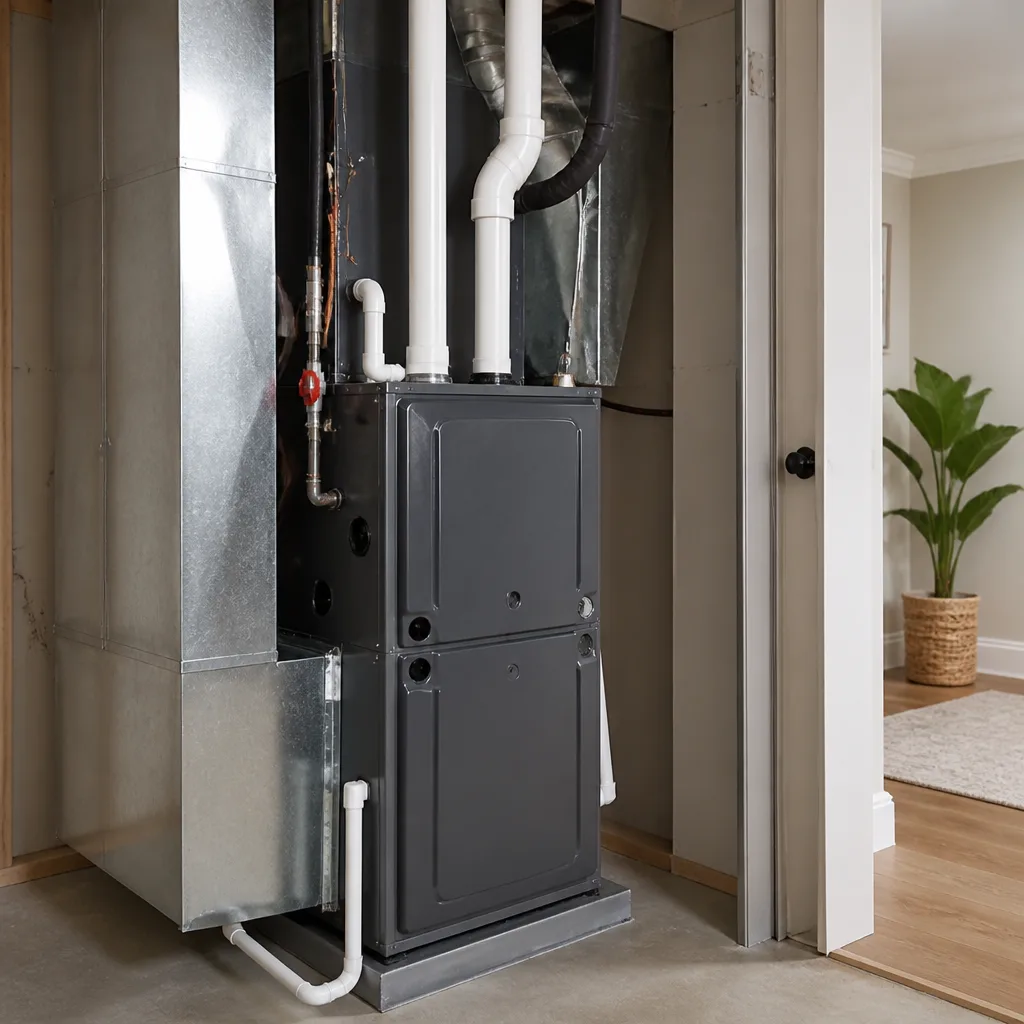 Furnace & heating
 AC repair
 Heat pumps
 Ductless mini splits
 Carrier
 Trane
 Goodman
Seasonal tune-up and full diagnostic on your Carrier, Trane, or Goodman system - readings shown to you before any repair is proposed
Diagnosis first, numbers second - you approve the repair price before a single part goes in.
Get your free estimateDIY vs Professional Heating & Furnace: What’s Safe to Do Yourself
There are YouTube videos with half a million views showing homeowners how to swap out a furnace gas valve. Ray has walked into three homes where someone actually tried it. Two of those calls came from a neighbor who smelled gas before the homeowner did. That’s the whole difference between furnace work and AC work in a nutshell. When a cooling repair goes wrong, you sweat and you call somebody. When a gas repair goes wrong, you might not know it until the fire department shows up. This guide walks through exactly where the DIY line sits for heating equipment in North Las Vegas – what you can safely handle, what Nevada law says about gas work, and why “I’ll just watch it and see if it gets worse” is a strategy that works fine for air conditioning and fails dangerously for a furnace.
Quick Answer
You can safely replace a furnace filter, swap a thermostat on a low-voltage system, install carbon monoxide detectors, and eyeball your vent pipes for obvious damage. You cannot legally or safely disconnect gas lines, replace a gas valve, clean a heat exchanger, or open a burner assembly in Nevada – that work requires a licensed contractor, and the failure mode is carbon monoxide poisoning or fire, not just an uncomfortable house. When in doubt on anything gas-fired, the answer is professional.
Styles & brands we work with
- AC repair
- Furnace & heating
- Heat pumps
- Ductless mini splits
- Carrier
- Trane
- Goodman
Table of Contents
- Why furnace DIY is a different conversation than AC DIY
- What you can safely do yourself without a license
- What Nevada law says about gas appliance work
- Why gas valves, heat exchangers, and flue work are off-limits
- The real cost of “I’ll just watch it and see”
- How to verify a heating contractor’s license and insurance in Nevada
- North Las Vegas specifics: climate, homes, and what we see
- Frequently asked questions
Why Furnace DIY Is a Different Conversation Than AC DIY
Most homeowners in North Las Vegas are comfortable with the idea of poking at an air conditioner. The worst realistic outcome of a botched AC repair is a compressor that won’t start and a hot afternoon followed by an expensive call. Painful, but survivable. Furnace work is not the same risk profile.
A gas furnace has three things going on at once: combustion, a heat exchanger that separates combustion gases from the air you breathe, and a flue that carries those gases outside. Get any one of those wrong and you’re not dealing with a warranty issue or a failed inspection. You’re dealing with carbon monoxide in a closed house.
That’s why the skills question is almost beside the point. A capable homeowner with a good wrench set can physically remove a gas valve. Plenty of people have. The problem is what happens after. A gas joint that’s 95 percent right leaks. A heat exchanger with a hairline crack that wasn’t visible during a DIY inspection puts CO into the airstream every time the burners fire. A flue that isn’t seated exactly right spills exhaust back into the room.
We get called to North Las Vegas homes where a homeowner replaced a thermostat or a filter and then hit a wall on the gas side. That’s the right instinct. The filter went fine, the gas line scared them, and they stopped. We’d rather hear that story than the other one. If you want the full picture of what proper furnace service actually includes, our Heating & Furnace in North Las Vegas page lays it out.
What You Can Safely Do Yourself Without a License
Plenty of heating maintenance is not only safe but smart. Doing these four things keeps your system running better and gives a technician less to catch on a service call.
1. Replace the air filter
Once a month during heating season, more if you have pets or a lot of dust coming in off the desert. A clogged filter restricts airflow, makes the blower work harder, and in North Las Vegas during a windy spring it can foul up fast. Filters are cheap, the swap takes two minutes, and it’s fully within reach. Never run a furnace without one.
2. Replace a thermostat on a low-voltage system
Standard household thermostats run on low-voltage wiring, usually 24 volts. Swapping one for a newer programmable or smart model is a common DIY job and reasonably safe if you turn off the furnace at the breaker first and match the wire labels to the terminals. The moment you’re dealing with line-voltage wiring, a heat pump’s reversing control, or anything that doesn’t match the manual, stop and call.
3. Install carbon monoxide detectors
Every home with any gas appliance should have one on each level and near sleeping areas. This is a plug-in, wall-mount, or hardwired task a homeowner can absolutely handle. It’s the single best safety investment you can make, and it backs up everything else in this guide.
4. Visually inspect your vent pipe and flue connections
Look at the metal flue pipe coming off the furnace. Check that each joint is fitted together, that the pipe isn’t rusted through or disconnected, and that nothing has been stacked against it in the basement or utility closet. Confirm the vent ends safely outside. You’re looking, not taking anything apart. If something looks loose, cracked, or out of place, that’s the call.
What Nevada Law Says About Gas Appliance Work
This is where a lot of capable homeowners get surprised. The question of who can legally touch a gas line in Nevada is regulated at the state level, and it’s not a gray area.
Nevada Revised Statutes Chapter 624 governs contractors, and the Nevada State Contractors Board licenses and regulates the trades that include heating, ventilation, and air conditioning. Gas piping and gas appliance connection work is additionally regulated through the State Plumbing Board’s jurisdiction. The practical upshot: disconnecting a gas line from a furnace, reconnecting it after a repair, and any work on the gas valve, burner, or flue is licensed tradesman territory. A homeowner doing it for pay without a license is a problem. A homeowner doing it in their own home takes on both the legal risk and the safety risk of unpermitted, uninspected gas work.
Here’s why that matters beyond the paperwork. If a fire or a CO incident traces back to unpermitted gas work, an insurance claim can get complicated in a hurry. A properly licensed contractor pulls the permit, does the work to code, and stands behind it. Our guide to Ray’s Heating & Air North Las Vegas home explains how we handle that side of every job.
Why Gas Valves, Heat Exchangers, and Flue Work Are Off-Limits
The usual DIY instinct is to sort things by difficulty. That’s the wrong lens here. A gas valve isn’t technically difficult to remove. A burner assembly isn’t a puzzle. The reason to leave these alone isn’t that you can’t physically do it. It’s that the failure mode is poisoning or fire, and neither announces itself.
- Gas valve: a valve that seats 98 percent right still leaks. You can’t smell a small leak reliably, and the leak can sit there for months slowly building up in a utility closet or basement.
- Heat exchanger: the metal separating combustion gases from the air you breathe. Cracks and pinholes often aren’t visible without a camera and a trained eye. A cracked exchanger pushes carbon monoxide into every room the ductwork feeds.
- Burner assembly: misaligned burners cause incomplete combustion and flame rollout. Flame where flame shouldn’t be means fire risk and CO at the same time.
- Flue and venting: if the flue isn’t seated, perfectly pitched, and clear, exhaust spills back into the house instead of going up the chimney. This is a classic CO scenario and it looks fine from the outside.
We’ve seen this in North Las Vegas homes in older neighborhoods where utility configurations vary and vent runs aren’t always textbook. A recent example: a homeowner had pulled the flue pipe off to clean it and set it back slightly off-angle. Everything looked normal. The CO detector didn’t go off for a few days of mild weather until the furnace ran long enough to trip it. That’s the terrifying part. The furnace doesn’t tell you.
The Real Cost of “I’ll Just Watch It and See”
This is the part where furnace thinking and AC thinking split hardest. On an air conditioner, a small refrigerant leak can go from a small recharge to a compressor replacement if you ignore it long enough. Annoying and expensive, but you’ll get around to it. On a furnace, “watch it and see” is a completely different bet.
If your furnace is short-cycling, making a strange noise, or leaving soot streaks, those are combustion symptoms. Some are harmless, some aren’t. You can’t tell from the outside which is which. A furnace that’s producing carbon monoxide at a slow rate doesn’t smell bad, doesn’t usually announce itself with a bang, and by the time the symptoms show up in people – headaches, fatigue, nausea – the exposure has been happening for a while.
The asymmetry is brutal. A house being uncomfortably cold in December in North Las Vegas is a comfort problem. A house with a slow combustion leak is a health emergency that feels like a comfort problem. The two look the same from the hallway. The only way to tell them apart is a technician with a combustion analyzer and a CO monitor.
If your furnace is having a hard time right now, don’t wait the weekend to see if it clears up. Call us at (844) 761-6871 and we’ll get someone out to run the readings.
How to Verify a Heating Contractor’s License and Insurance in Nevada
This step takes five minutes and it’s the difference between hiring a real heating contractor and handing a stranger access to your gas lines. Here’s the exact process for Nevada.
- Go to the Nevada State Contractors Board website. The NSCB publishes a searchable license database at nscb.nv.gov. Every legal contractor working in North Las Vegas and the rest of Nevada has a license number you can look up.
- Search the business name or license number. Verify the license status is “active,” the license classification covers heating and air conditioning or plumbing as applicable, and the business name on file matches the name on the estimate.
- Check for a bond and insurance on file. The NSCB record shows whether the contractor has an active surety bond and general liability coverage. If either is missing, walk away.
- Ask to see the license card at the door. Any legitimate contractor carries their license card. A company that can’t produce one, or produces one in someone else’s name that doesn’t match the invoice, is a red flag.
- Ask for a certificate of insurance for the specific job. General liability plus workers’ compensation. Anything less and you’re exposed if somebody gets hurt on your property.
One more check that costs nothing: call the number on the estimate and see if a human answers. Ray’s Heating & Air has its name, address, and license number published, and someone picks up the phone at three in the morning. If a company won’t put its name on the paperwork, that tells you something.
For more on how our own furnace service works and what a proper combustion check looks like, see our AC Repair & Installation in North Las Vegas page for the cooling side and the heating page for the furnace side.
North Las Vegas Specifics: Climate, Homes, and What We See
North Las Vegas has a few things going on with heating that shape this conversation in ways a generic guide can’t cover.
First, heating season is short and mild most years, which means a lot of homeowners skip the annual furnace check entirely. Furnaces sit for nine months untouched, then get turned on in December. That’s exactly when rusted flues, blocked vents, and stale gas joints show up. A check in October catches a lot of it early and cheaply.
Second, older North Las Vegas neighborhoods have a mix of furnace ages and configurations that vary block by block. A 1990s Goodman in one house and a newer Rheem or York in the next. Some flues route up through a tight utility closet with limited airflow. Some vent into a chimney shared with a water heater. That shared flue is a common source of backdrafting when the water heater and furnace fire at the same time – and that’s a CO scenario. A combustion test on both appliances catches it.
Third, the dust. Our spring winds bring a lot of particulate through the return. Filters load up faster here than in wetter climates. That’s the single easiest DIY task and the one most often neglected. Change it monthly in spring. If your dust is bad enough that filters clog in three weeks, call us about filtration and air quality upgrades.
If you’re considering a heat pump or mini-split as a replacement, that’s a different but related conversation about what’s safe to touch. See our Heat Pump & Mini Split in North Las Vegas page – short answer, refrigerant lines and electrical hookups stay in professional hands too.
Common Mistakes to Avoid
- Watching a gas valve video and thinking “I could do that.” You probably could, physically. The problem is the joint that looks fine and leaks carbon monoxide for months. The failure mode is the reason this one is a call, not the difficulty.
- Reconnecting a flue pipe slightly off angle after cleaning. It looks seated from the outside. It isn’t. Exhaust spills into the room instead of out the roof. We’ve seen homes in North Las Vegas trigger a CO detector days after a flue got knocked loose during unrelated work.
- Skipping the annual furnace check because it “worked fine last year.” A furnace can run and produce carbon monoxide at the same time. The check is cheap. The alternative isn’t.
- Relying on a smoke detector as CO coverage. A smoke detector does not detect carbon monoxide. You need a dedicated CO detector, ideally on every level and near bedrooms.
- Buying a furnace from a box store and hiring whoever’s cheapest to install it. Furnace installation requires a load calculation, gas sizing, and a permit. In North Las Vegas, an unpermitted install is a problem at resale and a safety question the day it’s running.
- Running a furnace with visible flame roll-out or soot streaks. Those are combustion failures, not quirks. Shut it off at the breaker and call somebody.
- Letting a contractor onto your gas line without verifying the NSCB license. Five minutes on nscb.nv.gov is the cheapest insurance you’ll ever buy.
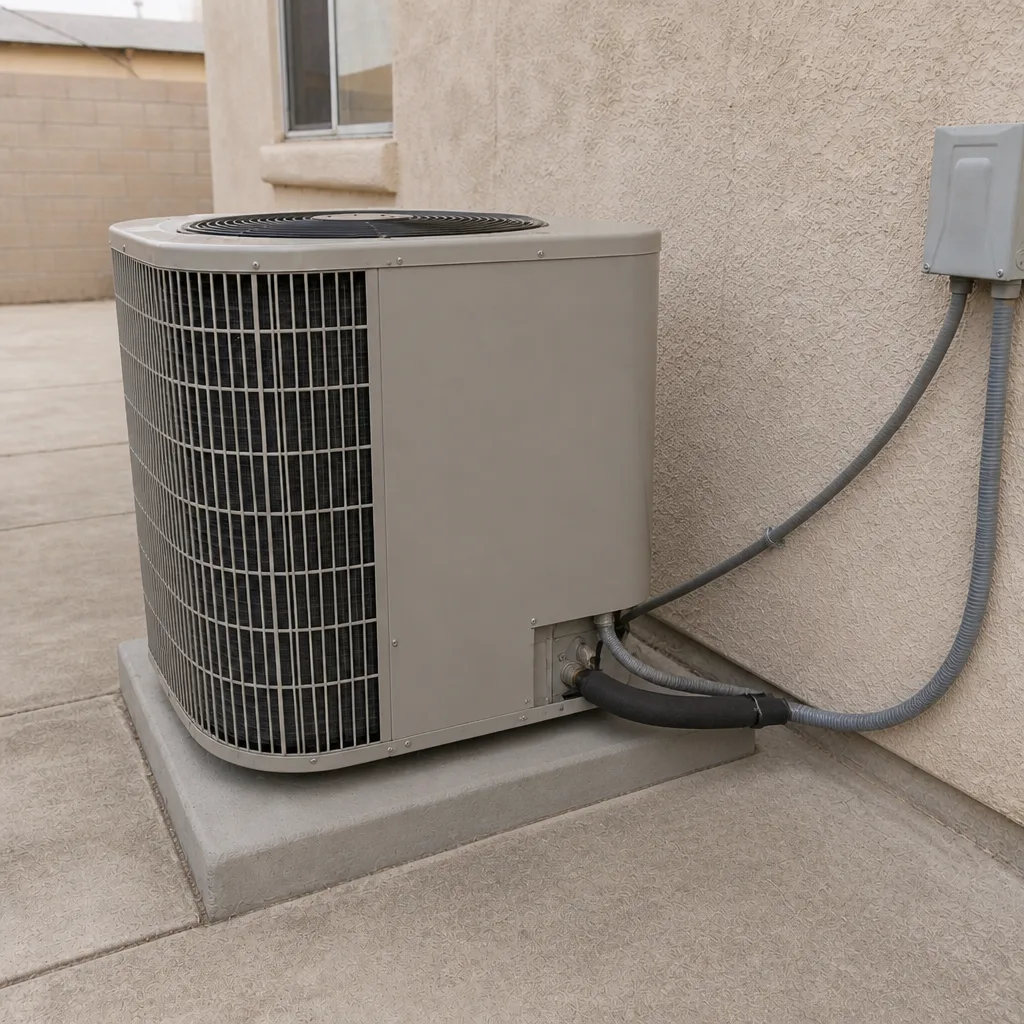
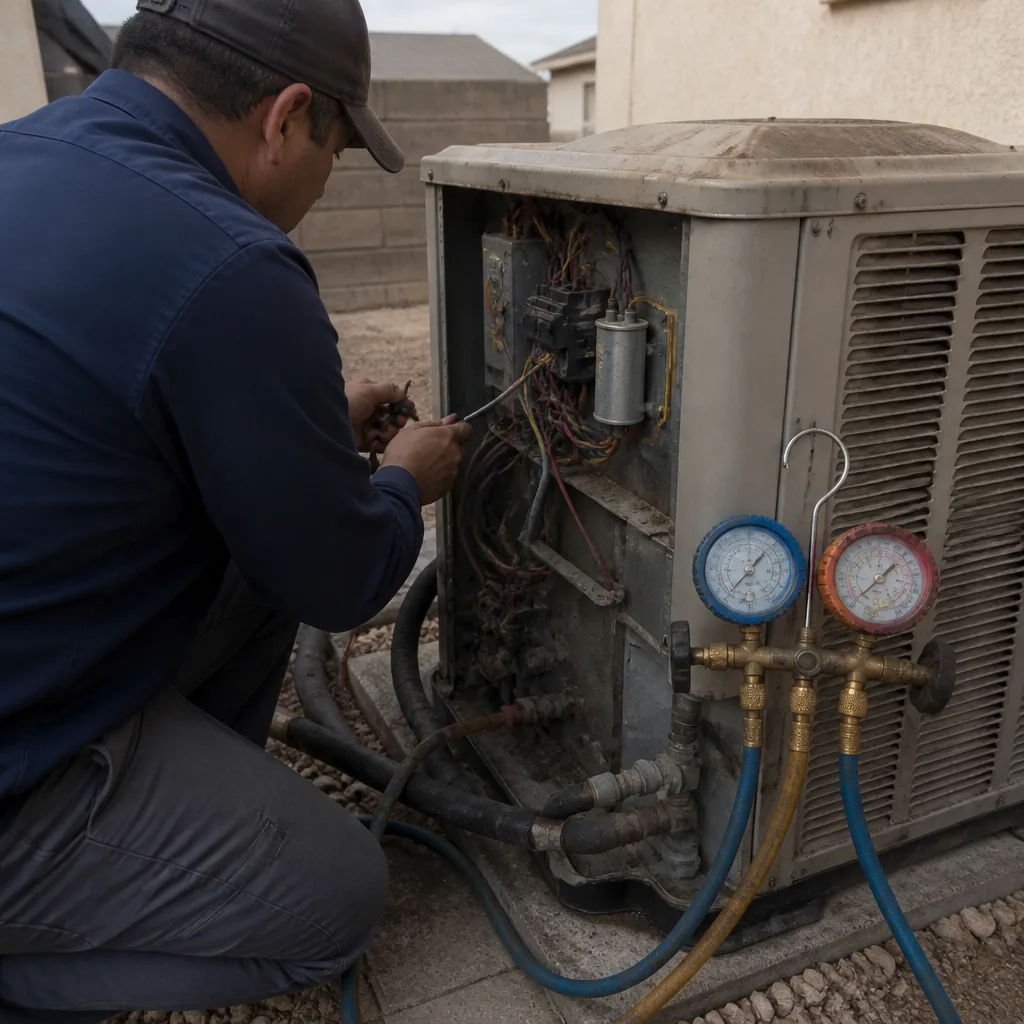
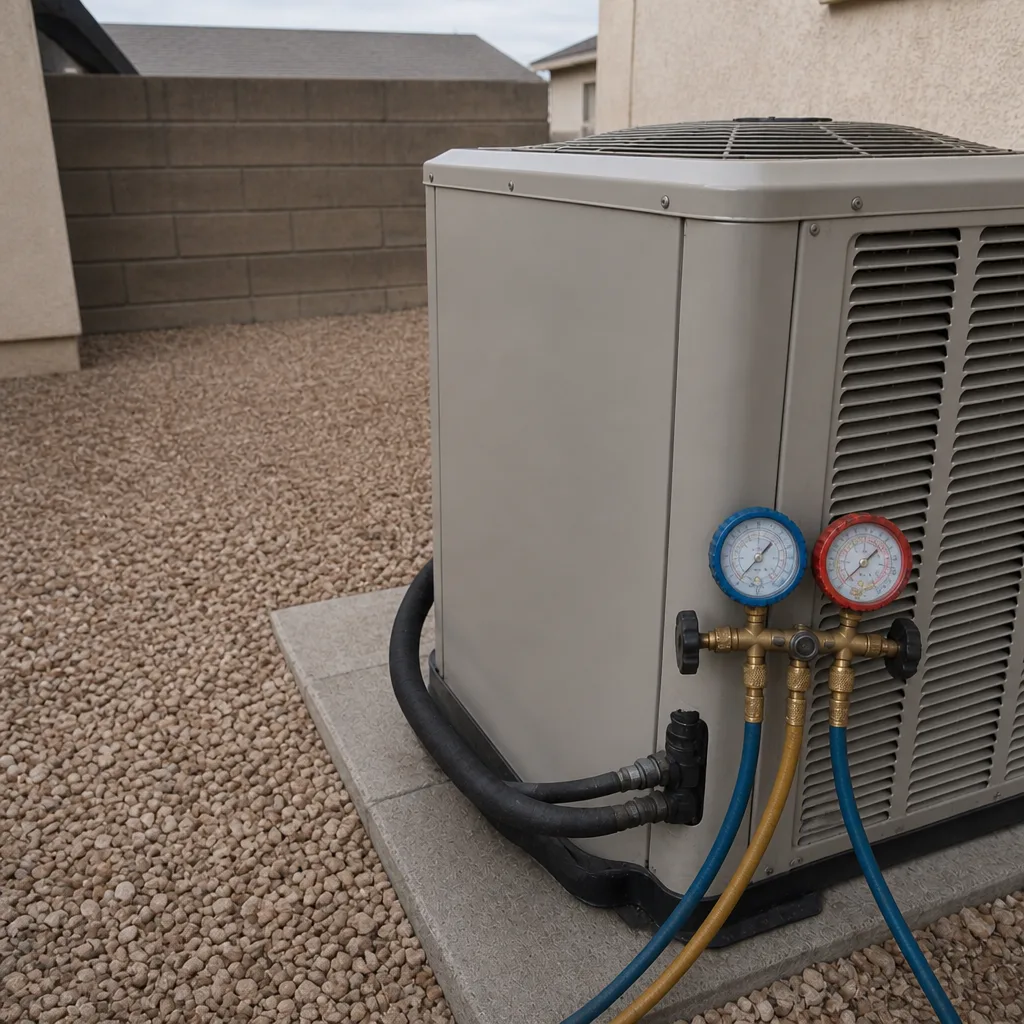
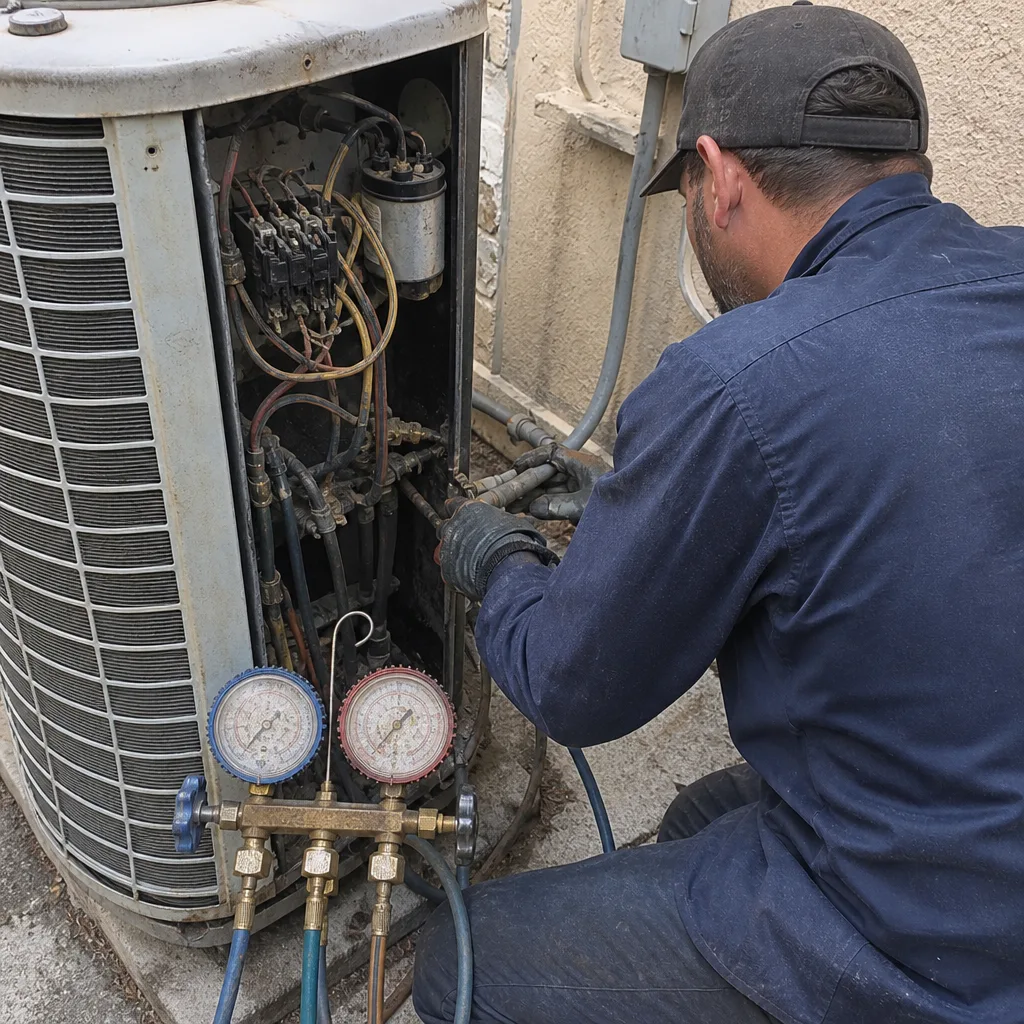
See the difference
 Before
 After
 Before
 After
 Before
 After
When to Call a Professional
Call a professional immediately if you smell gas, if your CO detector sounds, if you see flame roll-out, soot streaks, or a yellow lazy flame instead of a crisp blue one, or if your vent pipe is disconnected, rusted through, or loose. Those are emergency calls and you shouldn’t wait. Call from a safe location, get everyone out of the house if you smell gas, and don’t turn anything on or off.
Call for anything involving the gas valve, the burner assembly, the heat exchanger, the flue, or the gas piping. That’s not a DIY zone regardless of how handy you are. And call for a real combustion check once a year, ideally before the first cold snap. A short 15-minute check that reads your combustion numbers and confirms the flue is drafting catches most of the dangerous stuff before it becomes an emergency.
Ray’s Heating & Air North Las Vegas offers free estimates in North Las Vegas and we answer the phone with a live person around the clock. If you’re not sure whether your furnace issue is a DIY afternoon or a same-day call, just call (844) 761-6871 and ask. No trip charge inside the county, and we’ll tell you straight.
Frequently Asked Questions
Yes, and you should. Filter replacement is the safest and highest-value DIY heating task there is. Change it monthly during heating season and more often during dusty spring months in North Las Vegas. A clogged filter restricts airflow, drives up energy costs, and stresses the blower. It’s the first thing any honest technician will check.
Not for hire and not to code. Gas piping and gas appliance connection work in Nevada falls under licensed contractor requirements through NRS 624 and the State Plumbing Board. As a homeowner you can disconnect a gas line in the strict physical sense, but doing so without a permit and inspection creates safety and insurance exposure. The practical answer: leave gas work to a licensed contractor.
Use the Nevada State Contractors Board searchable database at nscb.nv.gov and look up the business by name or license number. Confirm the license is active, the classification covers heating and air conditioning, and the surety bond and insurance are on file. Ask to see the license card at the door and request a certificate of insurance for your job. Ray’s Heating & Air publishes its license number, address, and name so you can verify before you call.
An AC failure is uncomfortable. A furnace failure can be dangerous. When cooling fails, the worst outcome is a hot house and an expensive compressor replacement. When a furnace fails in a combustion-related way – a gas leak, a cracked heat exchanger, a bad flue – the outcome can be carbon monoxide poisoning or fire. That asymmetry is why we recommend licensed professionals for anything gas-side even for skilled DIY homeowners.
Yes, and do it this weekend. CO detectors are affordable, widely available, and safe to install yourself. Put one on every level of your home and one near each sleeping area. If your CO detector sounds at any point, treat it as an emergency: get out of the house and call 911 first, then call us after you’re safe.
Depends on the noise, and you can’t tell which is which without a combustion check. A rattle might be a loose blower panel. A low rumble, a whoosh at startup, or a banging could be delayed ignition – a combustion issue that isn’t safe to leave running. If you’re not sure, shut it off at the breaker and call. We’d rather come out for something harmless than read about a fire later.
The Bottom Line
Furnace DIY is a shorter list than most homeowners hope, and that’s for a good reason. Filter swaps, thermostat replacements on low-voltage systems, CO detector installs, and visual vent inspections are firmly in the homeowner’s hands. Gas valves, burner assemblies, heat exchangers, flue work, and gas piping are not – not because they’re technically hard, but because the failure mode is poisoning or fire. North Las Vegas has a short heating season and hot, dusty springs that make an annual furnace check the cheapest safety purchase you’ll make. Verify your contractor through the Nevada State Contractors Board before anyone touches your gas line. And if your furnace is acting up and you’re not sure which side of the line you’re on, just call and ask.
Ray’s Heating & Air North Las Vegas has been locally owned and owner-operated since 2002, services all major brands including Goodman, Rheem, York, and Daikin, and backs every job with the 90-Day Done Right Promise in writing. Free second opinion on any written estimate, no trip charge inside the county, and the phone answered by a live person around the clock. Call (844) 761-6871 for a free estimate and we’ll take a look.
Written by the team at Ray’s Heating & Air North Las Vegas.