
Last updated November 17, 2026
 AC repair
 Furnace & heating
 Heat pumps
 Ductless mini splits
 Carrier
 Trane
 Goodman
Seasonal tune-up and full diagnostic on your Carrier, Trane, or Goodman system - readings shown to you before any repair is proposed
Diagnosis first, numbers second - you approve the repair price before a single part goes in.
Get your free estimateHVAC Warning Signs: A North Las Vegas Homeowner’s Reference Guide
A system that’s about to lose its compressor in August usually tells you in May. It runs a little longer. The house takes an extra 20 minutes to cool. The electric bill ticks up $30. Most people chalk it up to “it’s getting hot.” We chalk it up to a refrigerant charge that’s been slowly off since the last guy worked on it. In North Las Vegas, the dramatic failures – the ones that hit at 11 PM on a Friday in July – almost always have months of quiet signals behind them. This guide maps those signals to their likely causes so you can act before the emergency call, not after it.
Quick Answer
The HVAC warning signs that matter most in North Las Vegas are the slow ones: cycles running longer month over month, electric bills creeping up $20 to $50, a house that reaches setpoint 15 to 20 minutes late, and small noises or smells that repeat. Dramatic symptoms like no cold air at all are late-stage. Catch the quiet signals early and you’re usually looking at a repair that costs a few hundred dollars instead of a compressor replacement over $1,200.
Styles & brands we work with
- AC repair
- Furnace & heating
- Heat pumps
- Ductless mini splits
- Carrier
- Trane
- Goodman
Table of Contents
- The Runtime Creep: The Signal Most Homeowners Miss
- What Different Smells Actually Mean
- Refrigerant Leak vs. Dirty Coil: Two Identical Symptoms, Two Very Different Costs
- Ice on the Unit: The $0 Fix and the $1,200 Fix
- Warning Signs That Are Actually Normal Here
- Reading Your Electric Bill Like a Diagnostic Tool
- Why Shoulder Months Matter in North Las Vegas
- How to Track All of This in Under Five Minutes a Month
The Runtime Creep: The Signal Most Homeowners Miss
Here’s the one that quietly costs North Las Vegas homeowners thousands every summer, and it’s the easiest signal to track. We’re talking about runtime creep: your AC gradually running longer per cycle over consecutive months, even while the outdoor temperature stays roughly the same.
In a healthy system, on a 105°F day, a properly charged unit in a North Las Vegas home might cycle for 18 to 22 minutes to satisfy the thermostat. By July, if that same cycle now takes 28 to 32 minutes at the same outdoor temp, something changed. It could be a refrigerant charge that’s drifted, a dirty condenser coil letting heat soak in, a filter that hasn’t been swapped, or a failing capacitor that makes the compressor work harder to start.
Here’s how to track it without any fancy equipment:
- Pick a reference day each month – say, the 15th – and note the outdoor high from your phone’s weather app.
- Time one full cooling cycle (from when the outside unit kicks on to when it shuts off) with a stopwatch. Note the minutes.
- Write both numbers on a sticky note on the fridge. Sixty to ninety seconds of effort, once a month.
- Same outdoor temp but a cycle that’s 20% longer than two months ago? That’s a signal to look closer.
Most North Las Vegas homes have smart thermostats now, and many of those track runtime history in the app. Even a basic thermostat with a filter-reminder timer gives you a rough baseline. If your unit is a Bryant or a Trane with a communicating stat, you’ll often see runtime data in the app directly.
One note on what “normal” looks like: a system on a 110°F day in July will cycle longer than the same system on an 85°F day in April. That’s expected. What you’re watching for is a change at the same outdoor temperature, not absolute minutes. The trend line matters more than the number.
What Different Smells Actually Mean
Your nose is a legitimate diagnostic tool, and in North Las Vegas it picks up on things that don’t show up on a pressure gauge. Here’s what each smell type actually points to.
Burning, plastic, or hot-dust smell from the vents: On the first heat of the season, a faint burning dust smell is normal – dust on the heat exchanger cooking off. If the smell persists past the first 10 or 15 minutes, or it comes back mid-season, that’s a different story. It could be a blower motor overheating, a capacitor about to fail, or a wire making poor contact. Don’t run the system and go to bed. Shut it down and get it checked.
Musty, damp, or dirty-sock smell: This is almost always the evaporator coil. In North Las Vegas, we see this spike in the monsoon stretch – late July through early September – when humidity climbs enough that moisture sits on a dirty coil instead of draining away. The coil builds up a biological film, and every time airflow crosses it, that smell gets pushed into your house. A clean coil and a properly functioning condensate drain fix it. Leaving it usually means the coil gets worse and the efficiency drops with it.
Sulfur or rotten-egg smell: If you have a gas furnace and you smell sulfur – actually sulfur, not just the “organic” mustiness above – get out of the house and call your gas company from outside. This is a gas leak indicator, and it’s not something to investigate on your own. It’s rare, but it’s the one smell on this list where you don’t troubleshoot. If the smell is coming specifically from the AC side and it’s more like a dead-rodent smell, that’s usually the attic ductwork fished in by a rodent that got in through an unsealed attic vent – common in older North Las Vegas neighborhoods with single-story ranch homes.
Refrigerant Leak vs. Dirty Coil: Two Identical Symptoms, Two Very Different Costs
Here’s a scenario we see every month in North Las Vegas. Homeowner calls, says the AC runs all day and the house won’t get below 78. From inside the house, they could have a slow refrigerant leak or a dirty condenser coil. Both produce the exact same symptom. The urgency and the cost, though, are miles apart.
Dirty condenser coil: The outdoor coil (the one wrapped around the outside unit) is caked with dust, cottonwood fluff, dog hair, or that fine desert silt that seems to coat everything after a wind event. The system can’t reject heat, so it runs long and cools poorly. Fix: professional coil cleaning, typically $150 to $300 in the North Las Vegas market. Usually same-day. Some of the fix – gently hosing off the accessible outer coil – is homeowner-doable, but a proper chemical clean on a split system needs someone who knows what they’re touching.
Refrigerant leak: The charge has dropped below spec, and the system can’t cool properly because it’s literally short on refrigerant. Fix: locate and repair the leak (or replace the affected line/component), then recharge. That’s usually $350 to $900 depending on where the leak is, and sometimes more if the evaporator coil is the culprit. A “just top it off” approach doesn’t fix anything – the refrigerant escapes again, and you’ve paid twice.
Here’s how you tell which one you have before anyone shows up:
- Look at the outdoor unit. A heavily visible dust or cottonwood layer on the coil fins points to a dirty coil first.
- Feel the air coming from the supply vents. Weak airflow with cold-ish air suggests a coil restriction on the indoor side. Strong airflow that’s simply not cold suggests charge or outdoor-side issues.
- Check for oil residue around the outdoor unit’s service valves or copper lines. A slow refrigerant leak often leaves a faint oily film behind. Clean copper lines are a good sign; oily ones are not.
- If you’ve had a coil cleaned within the past year and the symptoms returned, the odds swing heavily toward a leak.
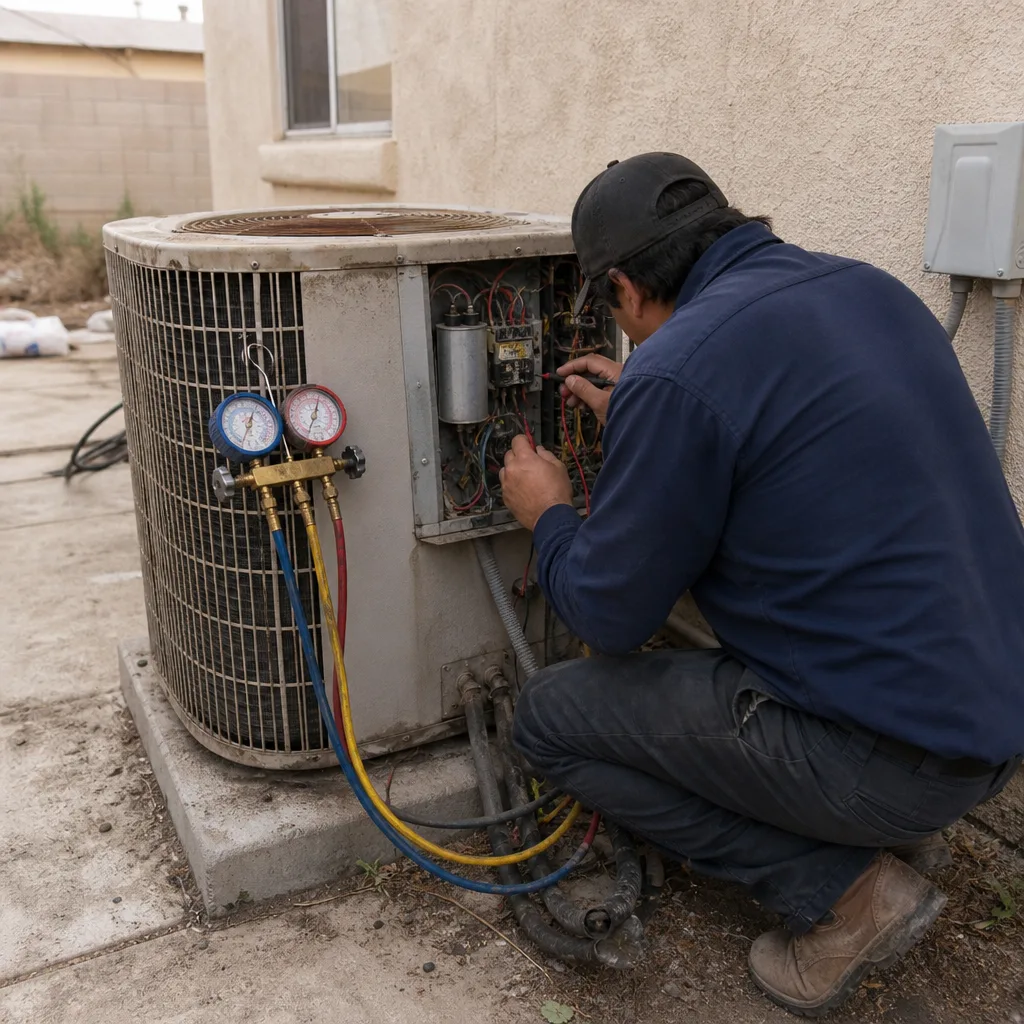
Getting a proper diagnosis means someone puts gauges on the system and reads superheat and subcool, not a guess from the driveway. Ray tests the capacitor before anyone says the word compressor, and the same principle applies here: readings first, numbers second. You should see both before any work starts.
For the full range of what AC repair in North Las Vegas typically runs, our AC repair and installation guide breaks down line-item pricing.
Ice on the Unit: The $0 Fix and the $1,200+ Fix
Nothing scares North Las Vegas homeowners quite like seeing ice on an AC unit when it’s 108°F outside. That’s an understandable reaction – it seems impossible – but ice on the refrigerant lines or the indoor coil is actually one of the more common summer service calls.
There are two causes we see over and over here, and one of them costs nothing to fix while the other can push past $1,200. Here’s how to tell which one you have.
Cause #1: Restricted airflow (the cheap one). A clogged air filter, a collapsed flex duct in the attic, or a closed return grille chokes the airflow across the evaporator coil. The coil gets too cold, and because it’s not getting enough warm air across it, it freezes solid. Fix: change the filter, open the register, or repair the duct. The $0 version of this fix is a filter you haven’t changed in six months. In North Las Vegas, during windy spring, that filter can load up in four to six weeks. If you can’t see light through it, it’s overdue. Duct repair on a collapsed run in the attic is usually $200 to $500.
Cause #2: Low refrigerant charge (the expensive one). Not enough refrigerant means the system runs at a lower pressure, the coil gets excessively cold, and it freezes. Fix: find and repair the leak and recharge. That’s usually $350 to $900, and if the leak is in the evaporator coil, you’re looking at a coil replacement that starts north of $1,200 in the North Las Vegas market.
How to tell the difference before calling:
- Turn the system off. Never run a frozen system.
- Check the filter – if it’s clogged, change it and try again after the ice melts (2 to 4 hours with the fan on, not the cool setting).
- If you have a clean filter and the unit freezes again after the ice melts, you have low refrigerant or a restriction. Call a technician.
- If it doesn’t freeze again, you caught it early with a filter change. Good.
One thing we strongly suggest you don’t do: try to “fix” refrigerant pressure yourself. Refrigerant is a regulated substance, and handling it wrong can cause severe frostbite or injury. This is a job for someone with the gauges, the training, and the license.
Warning Signs That Are Actually Normal Here
Let’s save you a few emergency calls. Some of what looks like trouble in North Las Vegas is just this climate doing its thing, and it’s not a problem.
Short cycling in the shoulder months. In March, April, October, and November, we get days where it’s 78°F outside and your system cools the house in three minutes and shuts off. Ten minutes later, it’s back on. That’s called short cycling, but when the outdoor temp is mild, it’s not a failure – it’s an oversized-for-the-load system or a two-stage system doing its job. It’s normal. Short cycling becomes a red flag when it happens on a 105°F day.
Startup noise on older units. A 12-year-old unit that makes a brief “clunk” or “hum-wallop” at startup is often just a compressor coming up to speed or a contactor closing. As long as it happens once, lasts a second or two, and the unit kicks in normally, it’s usually fine. What’s not fine: grinding, screaming, or repeated clicking attempts before the unit finally comes on. That’s a contactor or a start capacitor on the way out – common on units in their 8 to 15-year window, and not something to ignore.
A little water at the outdoor unit. In July and August, that monsoon humidity can cause the unit to sweat. A small puddle is normal. Large puddles that don’t drain away, or water pooling under the indoor air handler in the attic or closet, is not normal and should be checked – it usually means the condensate drain is clogged.
Higher bills in July and August. Yes, your bill is going to spike in July. That’s expected in North Las Vegas – the electric bill on a 2,000 square foot home can easily double from April to July. What we’re watching for is the bill jumping $40 or $50 higher than last July, with the same outdoor temps and the same habits. That’s where the runtime creep signal pays off.
Reading Your Electric Bill Like a Diagnostic Tool
The electric bill is the cheapest diagnostic tool in the house. Here’s how to read it as an HVAC signal, not just a bill.
Pull last July’s bill and this July’s bill (or last August and this August). Compare the total kWh, not the dollar amount – rates drift. If this August used 15% or more kWh than last August, with similar outdoor highs and similar household occupancy, something changed on the system. Now, HVAC is usually the biggest electrical load, so a meaningful baseline shift here is a strong hint your system is losing efficiency.
Common culprits behind a creeping bill, roughly in order of frequency we see in North Las Vegas:
- Dirty condenser coil restricting heat rejection (very common after a windy spring)
- A slowly failing capacitor making the compressor draw more amperage
- Duct leaks in the attic – especially on older homes in the Deer Springs and Aliante areas
- A refrigerant charge that’s dropped since the last service
- An aging system at the end of its useful life (typically 12 to 15 years)
Rule of thumb: a 10% or more year-over-year jump in summer kWh, on the same house with the same habits, is worth a service call. A 25% jump in kWh is a strong reason to have the system evaluated before you assume it’s going to make it through next summer. Small money now or a large money surprise later.
Why Shoulder Months Matter in North Las Vegas
March through May and September through November are the months the system gets ignored. It runs a little, the house stays comfortable, and no one thinks about the AC. That’s exactly the window when small issues turn into big ones.
What happens in shoulder months to a system that’s already compromised: the outdoor temp is mild, so the system runs short cycles. Short cycles mean less strain, so a failing capacitor or a slowly leaking charge doesn’t show up as poor cooling yet. But the compressor is starting up more often than it should. Each startup draws several times the running current. So a shoulder-season problem that “doesn’t bother us” is quietly eating the compressor’s life.
The smart play in North Las Vegas is to have the system looked at in April or May, before the first real heat wave. A tune-up in spring catches a weak capacitor, a dirty coil, and a charge issue weeks before they’d show up as “AC broke on the hottest weekend of the year.” Our heating and furnace service covers the same logic on the winter side – have the furnace checked in October, not December.
If your system is a heat pump, the shoulder months are even more important. A heat pump runs year-round, so it accumulates wear faster than a straight AC. We’ve written more about that specifically in our heat pump and mini split guide.
How to Track All of This in Under Five Minutes a Month
Here’s the whole system, in one place. Five minutes, once a month, and you’ll catch most North Las Vegas HVAC failures before they strand you in July.
- First of the month: Write down the outdoor high from the weather app and the time of one full cooling cycle. Sticky note, calendar app, notebook – whatever you’ll actually look at.
- First of the month, part two: Check the filter. Hold it up to a light. If you can’t see through it, swap it. In spring, this is a four-week check, not a monthly one.
- Quarterly: Look at the outdoor unit. Any obvious dust layer or cottonwood fluff on the coil? Note it. Any oil on the copper lines or the service valves? Note it.
- Seasonal (April and October): Pull last year’s electric bill for that month and compare kWh. Big jump without a lifestyle reason? Time for a service call.
- Every time your nose notices something: Write down what the smell was and where in the house. That’s a data point.
That’s it. If you do this and something looks off, you’ll have the actual numbers when you call, and the person on the other end can tell you in 30 seconds whether you need a same-day visit or can wait. If you don’t want to do the note-taking, that’s fine too – the systems we see most often in North Las Vegas homes (Carrier, Bryant, American Standard) all have smart thermostats available that track this automatically.
Common Mistakes to Avoid
- Assuming “no cold air” is the first sign. It’s usually the last one. The quiet signals – runtime creep, a bill that jumped $40, a slightly warmer house – almost always come first. Watch those and you’ll rarely be surprised.
- Topping off refrigerant instead of finding the leak. A system that’s low on refrigerant has a leak, full stop. Refrigerant doesn’t get used up. Topping it off without a leak search means you’ll be paying again in a few months. Ray won’t do a top-off without a leak search first, and you shouldn’t accept one.
- Running a frozen system to “see if it thaws.” If there’s ice on the indoor coil or the lines, turn the cool setting off. Running a frozen system can slug the compressor with liquid refrigerant, and that’s how you turn a $200 fix into a $1,400 one.
- Ignoring a burning smell because it goes away. A burning smell that recurs is a warning, not a fluke. Electrical components don’t heal themselves. Shut it down and have it looked at.
- Skipping the shoulder-season service because “it’s working fine.” In North Las Vegas, most of the failures we see in July were visible as small issues in April. The system was still working fine in April. It works fine until it doesn’t. A tune-up catches the small stuff early.
- Panic-calling over normal North Las Vegas behavior. Short cycling on a mild October day and a brief clunk at startup on an older unit are usually fine. Match the symptom to the temperature before you assume the worst. And don’t pay overtime for a call that can wait until Monday morning.
- Hiring whoever answers first. In North Las Vegas, the phone book is full of outfits that’ll quote one number on the phone and a different number at the door. Ask for the readings. Ask for the leak search. Ask for the price in writing before any work starts. If they won’t show you the numbers, that’s your answer.
See the difference
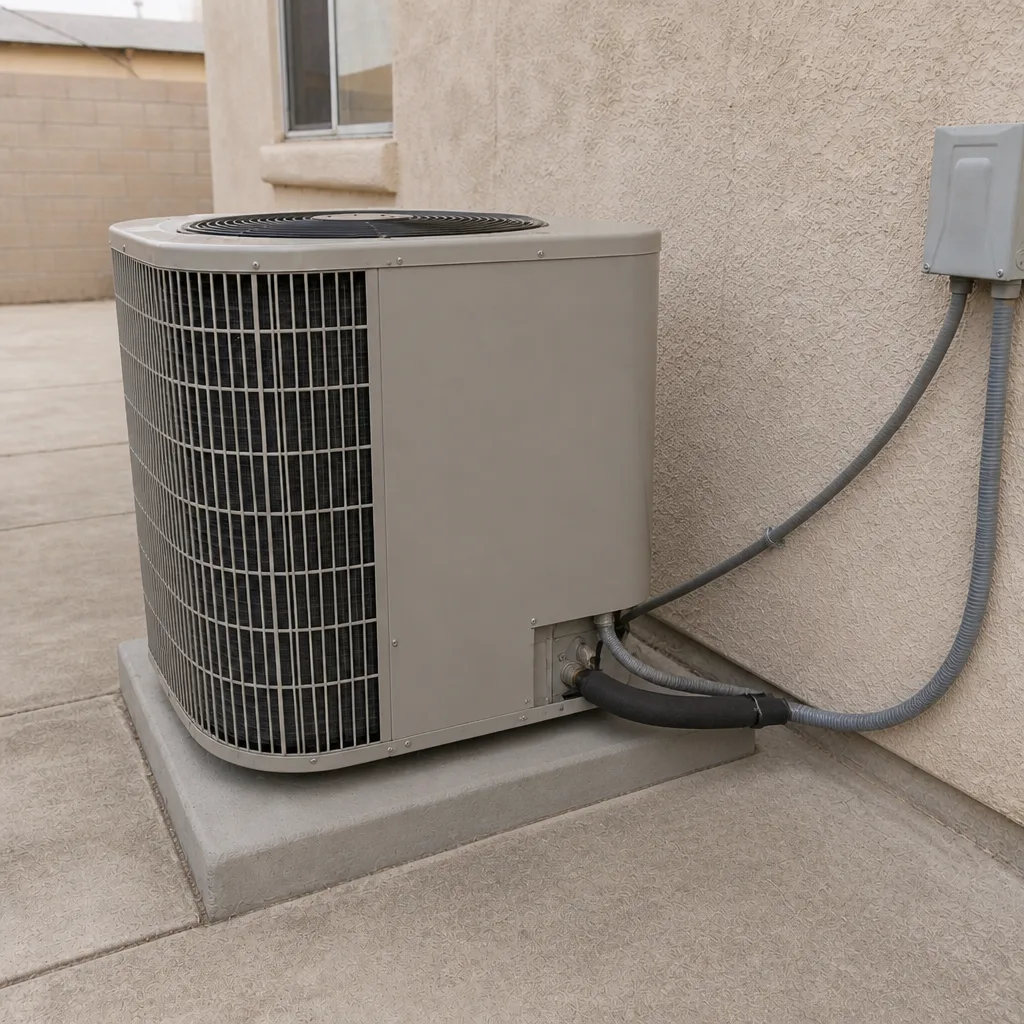
 Before
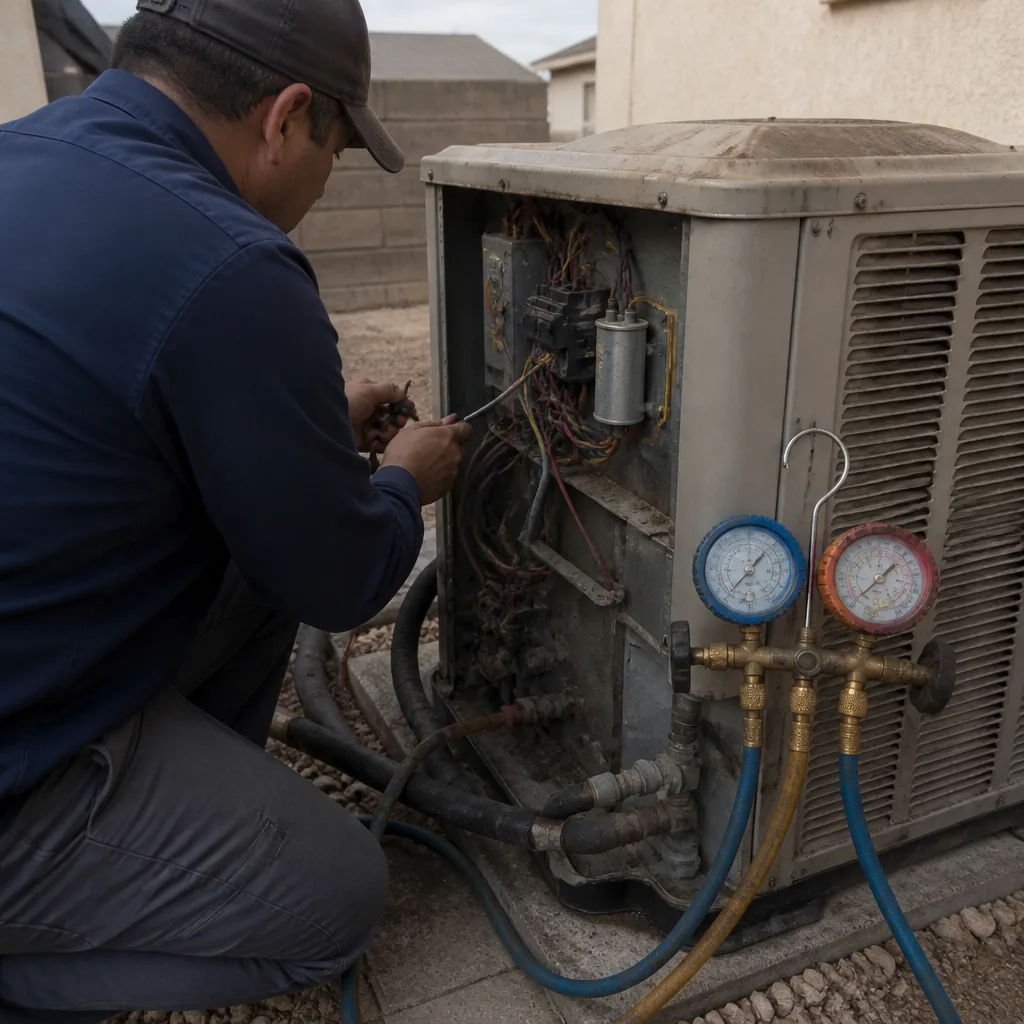
 After
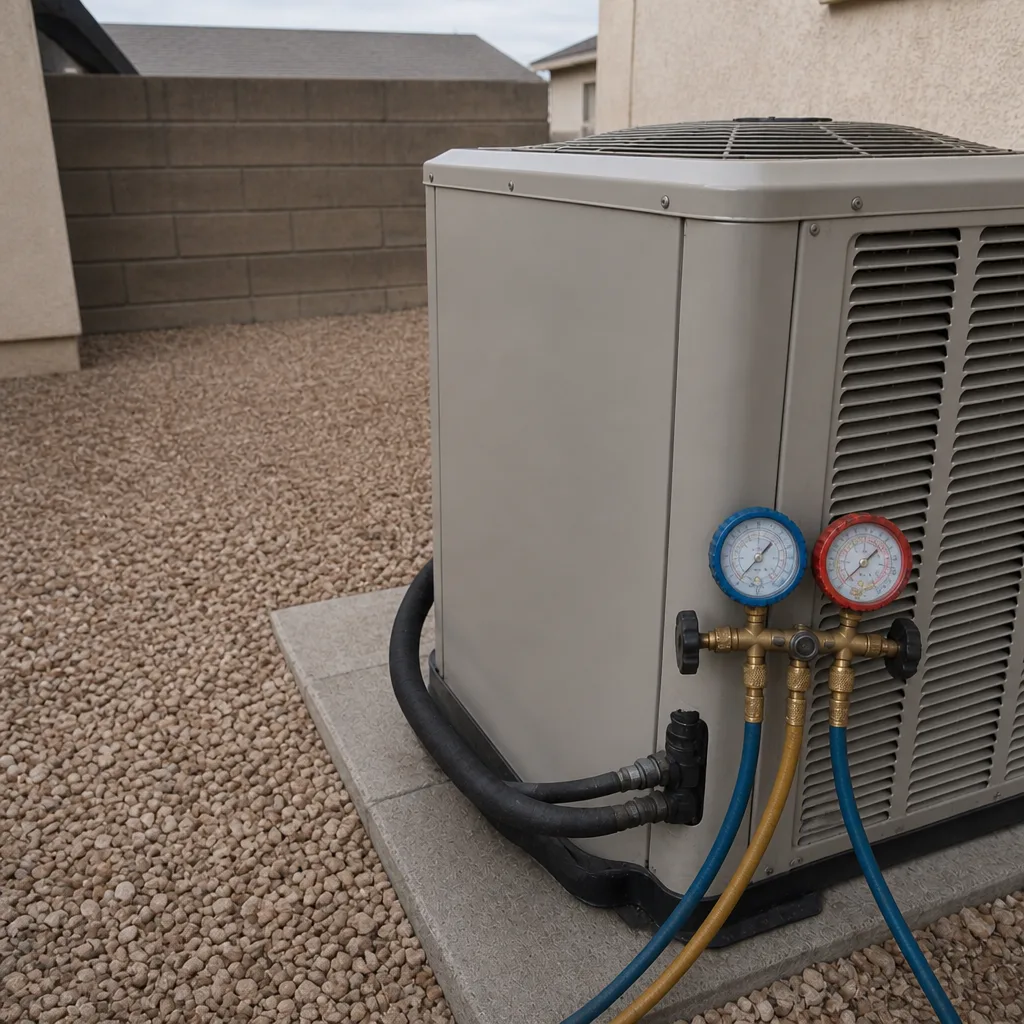
 Before
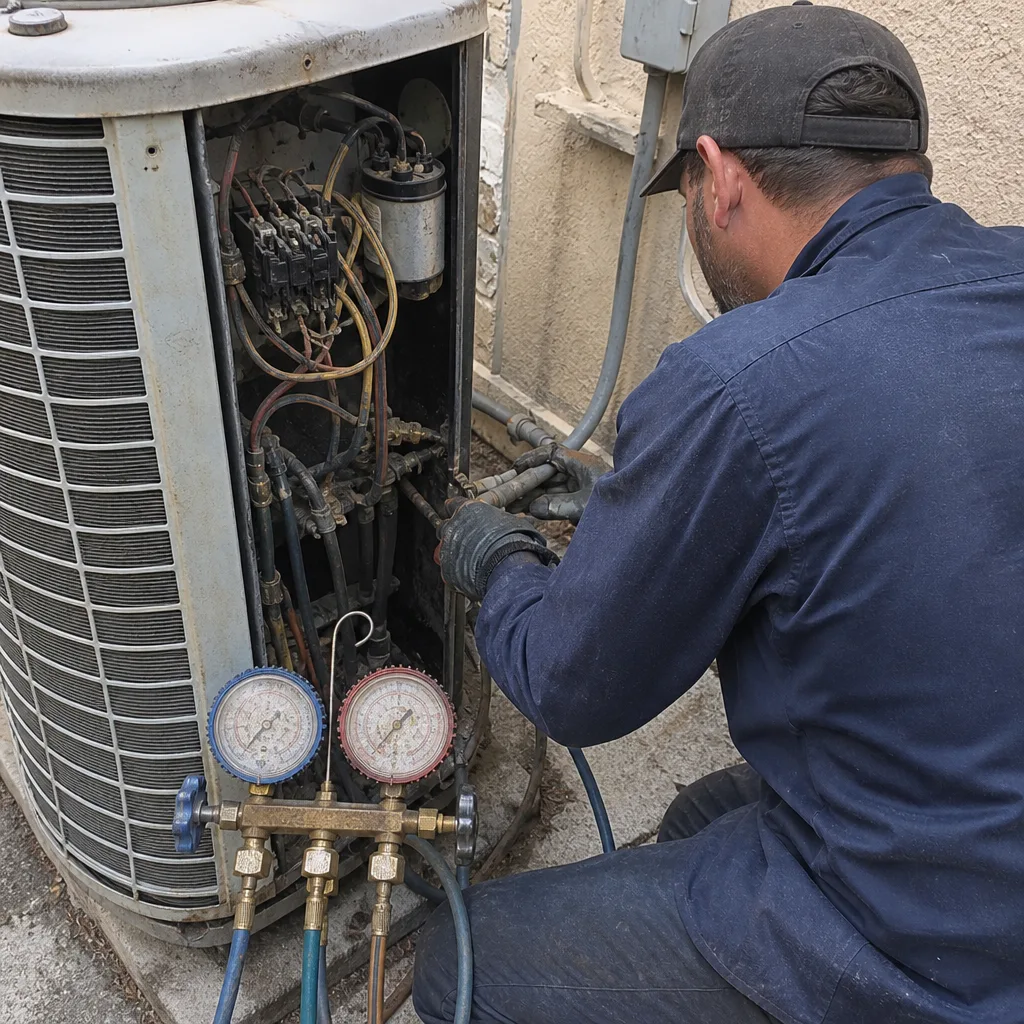
 After
 Before
 After
When to Call a Professional
Call someone the same day if any of these show up: ice on the indoor coil or lines after a filter change, a persistent burning smell, weak airflow that doesn’t improve with a clean filter, a bill that’s up 25% year over year with no other reason, a grinding or screaming noise at startup, or any refrigerant-related symptom (warm air from vents with the compressor running, oil on the outdoor lines, freezing). Any gas smell means call your gas company first, from outside the house.
For everything else, our Ray’s Heating & Air North Las Vegas home page is a good place to see what we do and how we work. Free estimates in North Las Vegas – call (844) 761-6871. Phones are answered by a live person, 24/7, and every job we do is backed by the 90-Day Done Right Promise in writing.
Frequently Asked Questions
Runtime creep – a cooling cycle that takes 20% longer than it did two months ago at the same outdoor temperature. It’s the earliest readable signal that something has drifted, whether it’s refrigerant charge, a dirty coil, or a failing capacitor. Track it once a month and you’ll catch most North Las Vegas failures weeks or months before they turn into an emergency call. If your cycle time is creeping up, call (844) 761-6871 and we’ll help you decide whether a visit is warranted.
It’s almost always the evaporator coil, and the timing is the tell. North Las Vegas monsoon humidity spikes in late July and August, and moisture that sits on a dirty coil instead of draining properly builds a biological film. A coil clean and a condensate drain check usually fixes it. If the smell is coming from the vents specifically in the first minute of running and then fades, that’s also consistent with a coil issue. Call (844) 761-6871 for a free estimate – estimates are free.
Look at the outdoor unit first. A visible dust or cottonwood layer on the coil points to a dirty coil. Oil residue on the copper lines or service valves points to a refrigerant leak. A coil clean runs $150 to $300; a leak repair or recharge runs $350 to $900, and an evaporator coil replacement starts north of $1,200. Getting this wrong is expensive, so a proper diagnosis with gauges and a leak search is worth the trip charge. Call (844) 761-6871 and we’ll get the readings before anyone touches anything.
Two causes – restricted airflow or low refrigerant. Restricted airflow is usually a clogged filter or a collapsed duct in the attic and costs nothing to a few hundred dollars to fix. Low refrigerant usually means a leak and runs $350 to $900, or higher if the evaporator coil is compromised. Turn the system off first, change the filter, and if it freezes again after thawing, it’s the refrigerant side. Call (844) 761-6871 for an exact quote – estimates are free.
No. In North Las Vegas shoulder months – October, April – a system that cools the house in three minutes and shuts off is often just doing its job. Short cycling becomes a red flag when it’s happening on a hot day (105°F+) or when the cycle is under 5 minutes repeatedly. On a hot day, it can point to an oversized system or a failing component. Call (844) 761-6871 if you’re not sure which you’re seeing.
If it involves ice, a burning smell, a gas smell, weak airflow that doesn’t resolve with a clean filter, refrigerant symptoms, or a grinding noise, call now. For a smell that’s mildly musty, a bill that’s up 10%, or a runtime creep you’re tracking, you can usually schedule a regular visit instead of an emergency one. Either way, call (844) 761-6871 and we’ll tell you straight whether it can wait.
The Bottom Line
The dramatic failures are the ones that make the news, but the quiet signals are the ones that save you money. Runtime creep, a bill that ticked up 15%, a cycle that takes 20 minutes longer, a smell you’ve been meaning to look into – those are the AC warning signs worth tracking in North Las Vegas. The dramatic symptom (no cold air) is almost always later than you wanted.
Do the five-minute monthly check. Get a spring tune-up before the first heat wave. And when something does look off, get the readings before you get a price. That’s the whole game here, and it’s not complicated.
Written by the team at Ray’s Heating & Air North Las Vegas.