
Last updated November 17, 2026
 Heat pumps
 AC repair
 Furnace & heating
 Ductless mini splits
 Carrier
 Trane
 Goodman
Seasonal tune-up and full diagnostic on your Carrier, Trane, or Goodman system - readings shown to you before any repair is proposed
Diagnosis first, numbers second - you approve the repair price before a single part goes in.
Get your free estimateHeat Pump & Mini Split Warning Signs Every Homeowner Should Know
When your mini-split starts cycling on and off every eight minutes instead of every twenty, most people assume it’s the thermostat setting, or the filter, or just the weather. Ray sees that pattern and immediately thinks low refrigerant charge, because that’s what it almost always is. Mini-splits fail differently than central systems. The warning signs are subtler, they look like normal operation to an untrained eye, and in a North Las Vegas summer the gap between “something seems off” and “the compressor is dead” gets measured in days, not weeks. The unit runs under constant load here. Nothing gets a break. This guide covers the eight signals worth watching, what each one actually means, and the monthly checks you can do yourself in ten minutes with a flashlight.
Quick Answer
The most reliable warning signs of a failing heat pump or mini-split are short-cycling (running in shorter and shorter bursts), ice on the outdoor unit or refrigerant lines in summer, musty or burning smells, a unit that runs longer to reach the same temperature, oily residue on line fittings, and rising electric bills without a usage change. In North Las Vegas, any of these means call for a diagnostic rather than wait, because constant summer load turns small faults into compressor failures fast.
Styles & brands we work with
- AC repair
- Furnace & heating
- Heat pumps
- Ductless mini splits
- Carrier
- Trane
- Goodman
Table of Contents
- Short-Cycling: Why It’s a Diagnostic, Not an Annoyance
- Ice in Summer: The Counterintuitive Warning
- What Three Different Smells Tell You
- Performance Creep: When “It Still Works” Isn’t Good Enough
- The Monthly Outdoor Unit Checks Anyone Can Do
- Electrical Signals You Can Hear and Feel
- When to Call a Professional
- Frequently Asked Questions
Short-Cycling: Why It’s a Diagnostic, Not an Annoyance
Short-cycling is when your mini-split starts, runs for a few minutes, shuts off, and repeats. A healthy system in a well-sealed space runs long cycles, often 15 to 25 minutes, then rests. A short-cycling unit is telling you it can’t finish the job in one pass. There are three leading causes, and they don’t look alike once you know what to check.
Low refrigerant charge is the most common. The system senses pressure it doesn’t like and shuts off to protect the compressor. If the cycle time gets shorter over a few days, this is your prime suspect. Thermostat placement matters more than people realize. A wall or remote sensor near a sunny window, a lamp, or a supply vent will read the wrong temperature and trigger premature shutoffs. Oversizing is the one homeowners can’t diagnose themselves. An oversized unit cools the room so fast it never runs long enough to dehumidify, and the on-off rhythm repeats forever.
Here’s the tell that separates them: if cycle time is shrinking day by day, suspect charge. If it’s been doing this since install, suspect sizing. If it only misbehaves at certain times of day, look at sensor placement. In our experience, North Las Vegas homes in older pockets of the city, where additions and converted garages leave odd sensor placements, hit the thermostat cause more often than people expect. Before you call, note the on-time and off-time for two cycles. That number alone tells a technician a lot. Our Heat Pump & Mini Split in North Las Vegas team asks for it every time.
Ice in Summer: The Counterintuitive Warning
An air conditioner or heat pump can’t make ice in 110-degree heat unless something is wrong. When you see frost or ice on the outdoor unit or the insulated copper line, that’s refrigerant reaching temperatures it shouldn’t, usually because the system is low on charge or the airflow is choked. Ice is a symptom, not a cause, and it never resolves on its own.
The two causes look similar but get fixed differently:
- Low refrigerant charge: The system loses pressure through a leak, and the remaining refrigerant expands too cold. Ice forms at the indoor coil or the lineset, often first thing in the morning when outdoor temps are lowest.
- Airflow restriction: A clogged filter, blocked return, or a blower that’s losing speed means the coil can’t absorb enough heat, and it ices instead. Dirty coils on the outdoor unit do the same thing by limiting heat rejection.
In the Las Vegas Valley, monsoon weeks hit this hard. Storms blow fine dust into condenser coils, and if that dust hasn’t been washed out before the next heat wave, airflow drops and ice builds. Don’t chip at the ice or run the unit to melt it. Turn the system off, and call. Running a frosted unit stresses the compressor, and a compressor replacement on a mini-split can easily reach four figures. Our techs see more frozen coils in August than any other month, and the fix is unglamorous: leak check, recharge, and a good coil wash.
What Three Different Smells Tell You
Smells are the warning sign homeowners most often dismiss, and they’re the fastest way to sort a small fix from a serious one. Each smell points at a different component.
Musty or “wet basement” smell. On a ductless mini-split, condensate drains to a small pan. Standing water in that pan grows biological film, and in our dry climate that’s less common than on a humid coast, but monsoon months plus a partially clogged drain will do it. The fix is a drain and pan cleaning, usually same-day, and it stops the smell within hours.
Burning or hot plastic smell. This is electrical. It could be a loose wire at the disconnect, a failing contactor, or a motor winding that’s heating up. Stop the system and get it checked. Burning smells are not a “wait and see” item.
Refrigerant smell. Honestly, most people can’t smell refrigerant, and the ones who describe it usually compare it to something sharp and sweet. If you do smell it, treat it as urgent: shut the system off and get someone out. Refrigerant is not a health hazard in small leaks, but it does displace oxygen in a tight space, and it’s a sign the system is losing charge fast. Ray’s Heating & Air handles all three, and on refrigerant issues, the answer starts with a leak search, not a top-off. Topping off a leaking system is a temporary fix and a money pit.
Performance Creep: When “It Still Works” Isn’t Good Enough
The most dangerous warning sign of all is the one that isn’t dramatic. Your mini-split still comes on. It still blows cold. But it’s running thirty minutes to hit the same setpoint it used to hit in fifteen. Over a summer in North Las Vegas, that creep is how compressors die quietly.
Performance degradation usually traces to one of four causes:
- Fouled outdoor coil. The condenser sheds heat through its fins. Dust, cottonwood fluff, and dryer lint coat the fins and the unit works harder for less result. This is the most common cause locally, and the easiest to fix.
- Low charge, slow leak. Losing a small amount of refrigerant over years makes the system work longer per cycle. You won’t see ice yet. You’ll just pay more and get less.
- Failing capacitor or blower motor. The motor starts running slow or hot. It still spins, but not at full speed.
- Insulation breakdown on the lineset. Sun-baked insulation on the copper line cracks and falls away. Once the line is exposed, you’re bleeding efficiency into the desert air, and the compressor pulls more current to compensate.
The way to catch this is comparative: know how long your unit normally takes to hit setpoint, and notice when that changes. If you used to set it to 78 and it was there in twenty minutes, and now it takes forty, that’s your signal. A single comparison call to us confirms it, and our AC Repair & Installation in North Las Vegas team can usually find the cause on the first visit. We test the capacitor before anyone says the word compressor. Readings first, numbers second.
The Monthly Outdoor Unit Checks Anyone Can Do
You don’t need training to spot most of the problems above. Ten minutes a month with a flashlight and a garden hose catches more failures than any service plan. This is the routine we recommend to every homeowner we work with in North Las Vegas, and it works on Daikin, Bryant, and York systems the same way.
- Look at the coil color. The outdoor unit’s coil fins should be bright and clean, with light showing through. If they look gray, matted, or furry with dust, airflow is restricted. Rinse with a gentle hose spray (no pressure washer), and if that doesn’t clear it, call for a coil wash.
- Check the lineset insulation. Follow the two copper lines from the outdoor unit to the wall. The insulation should be intact, no cracks, no gaps, no sun-baked strips falling away. A cheap foam wrap from the hardware store can slow further damage, but a full re-insulation is a job for a tech.
- Wipe the fittings with a paper towel. Any oily residue around the connection points signals a slow refrigerant leak. Refrigerant carries oil with it, and where the oil finds a path out, the refrigerant goes too. If you find oil, that’s a call.
- Clear the base and surroundings. Two feet of clear space on all sides. No stored patio cushions, no planter boxes, no AC unit buried in shrubs. Restricted airflow is the most predictable cause of compressor death we see.
- Look for rust or standing water in the base pan. A rusted-out pan or a drain that won’t clear points to a drainage issue that will eventually short something electrical.
The other thing worth doing monthly: walk the indoor unit and check for water droplets or staining on the wall below the drain. A slow condensate leak stains drywall before it drips, and catching it early avoids a repair job that has nothing to do with HVAC.
Electrical Signals You Can Hear and Feel
Your system talks to you in non-visual ways, too, and a little attention catches electrical problems before they become failures. This is a warning-sign category most guides skip, and it’s exactly the kind of thing we’ve learned to listen for in older North Las Vegas neighborhoods where panel age and wiring conditions vary widely.
- Clicking that repeats: A contactor clicking on and off rapidly is a sign of a control fault or a capacitor going. It’s normal to hear a single click when the unit starts. Repetitive clicking is not.
- Buzzing at the outdoor unit: A low hum is fine. A loud buzz that drops out and comes back points to a failing contactor or wiring connection.
- Motor noise: A whine or grind that rises with motor speed means bearings are going. Shut it down.
- Breakers that trip: If your outdoor unit trips the breaker, stop resetting it. That’s a symptom, not a nuisance. Capacitor, compressor, or wiring problems can all cause it, and continuing to run it can destroy the compressor.
- Warm switch plate or smell of hot plastic at the disconnect: This is a stop-and-call moment. Loose wiring at the disconnect heats up over time. It’s inexpensive to fix early and dangerous to ignore.
Safety caveat: work inside the electrical panel and at the disconnect is genuinely dangerous, and a heat pump’s capacitor holds a charge even with power off. We test components in front of you when we’re there, but the panel itself is not a homeowner job.
When to Call a Professional
Some warning signs are calls. Some are “call now.” Here’s how to tell. Call immediately, even after hours, for any burning smell, refrigerant smell, ice on the unit, a system that won’t start at all in peak heat, or a breaker that keeps tripping. Tell the answering person the cycle time you measured, what you observed, and the model if you can read it off the unit. That saves time and gets a tech out faster.
Call at your convenience for a slow loss of performance, a unit running longer to hit setpoint, a musty smell that comes and goes, or oily residue on the line fittings. These aren’t emergencies, but they’re not wait-until-fall items either. In North Las Vegas, a slow leak has about a season before the compressor pays the price.
Ray’s Heating & Air North Las Vegas offers free estimates in North Las Vegas, no trip charge inside the county, and a standing Free Second Opinion on any written estimate. Call (844) 761-6871. If it’s not done right, we make it right, and one call brings us back, in writing. Our technicians have up to 24 years of experience, and we’ll send the same ones to your door next time.
Common Mistakes to Avoid
- Topping off refrigerant without finding the leak. A top-off fixes the symptom for a few months, then you’re paying again. A leak search costs more up front and far less over time.
- Chipping ice off the unit. You can bend fins or puncture a lineset. Turn the system off and call. The ice will melt on its own.
- Assuming a short-cycling unit has a thermostat problem. Charcoal-gray thermostats and cracked faceplates are cheap to replace, but a thermostat swap won’t fix a low refrigerant charge, and it wastes money and time. Confirm the cause first.
- Ignoring a breaker trip. Resetting a breaker repeatedly is the fastest way to turn a capacitor swap into a compressor replacement. Stop and call after the first trip.
- Skipping the annual coil wash. In the Las Vegas Valley, dust and monsoon debris clog condenser coils every year. A coil wash is the cheapest maintenance line on the invoice and the one that most prevents failures.
- Leaving mulch or shrubs tight against the outdoor unit. Two feet of clearance on every side. Landscaping that traps heat and blocks airflow kills compressors quietly.
- Assuming “it still runs” means “it’s fine.” Performance creep is the warning sign that fools the most homeowners. If it’s working harder, it’s telling you something.
See the difference
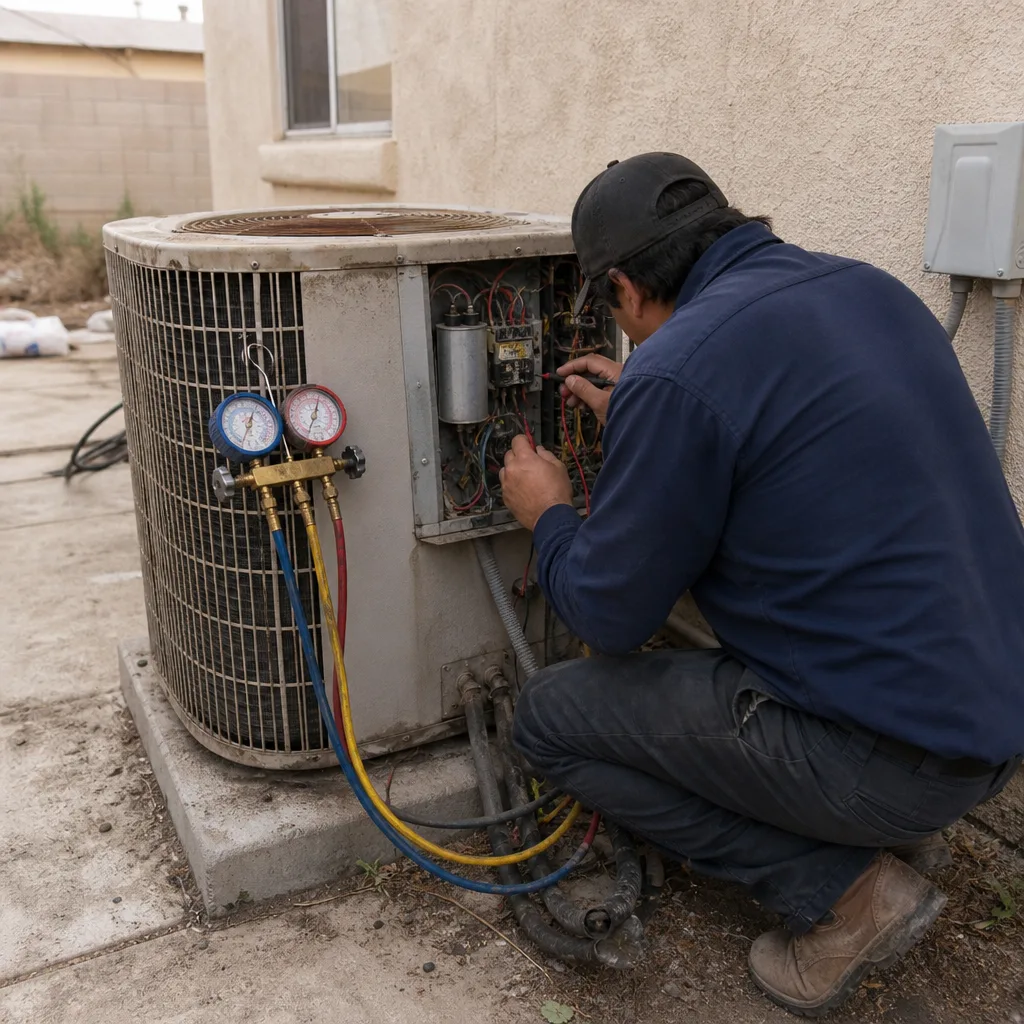 Before
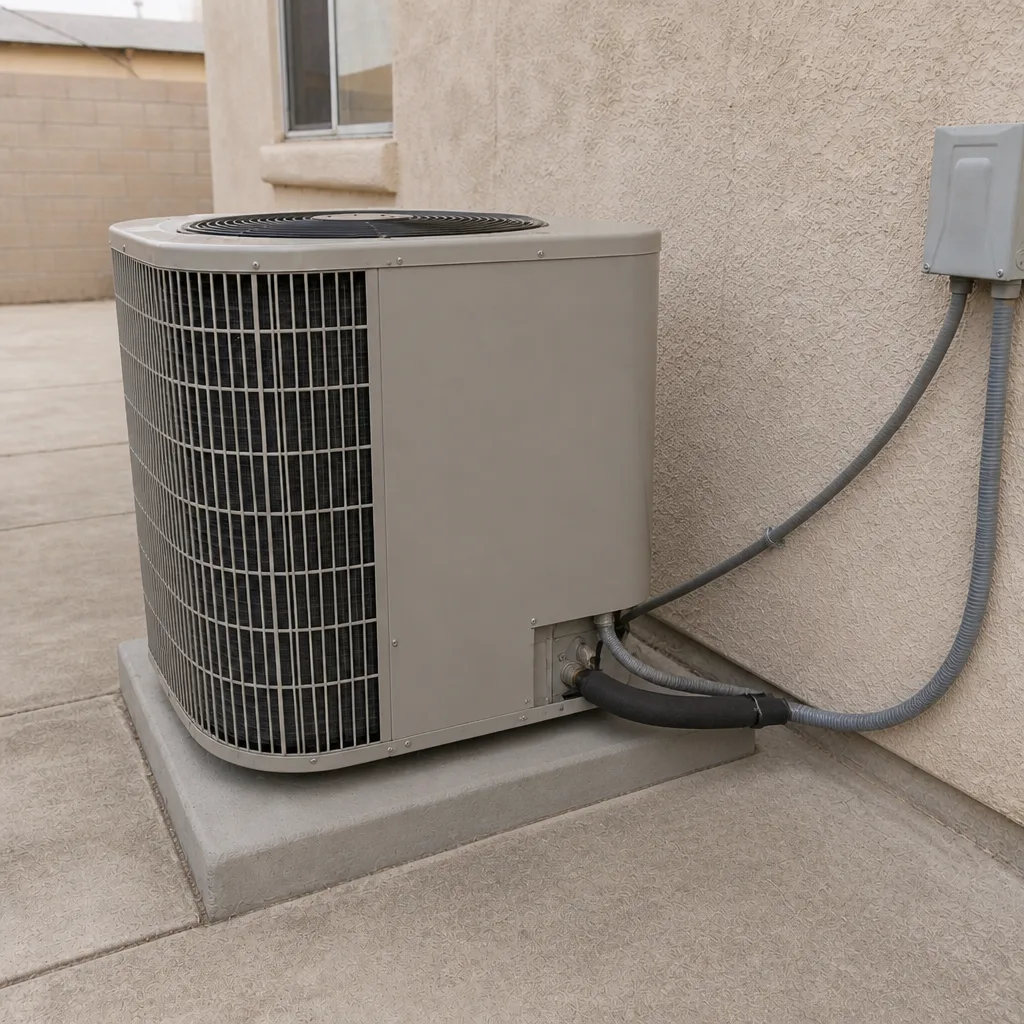 After
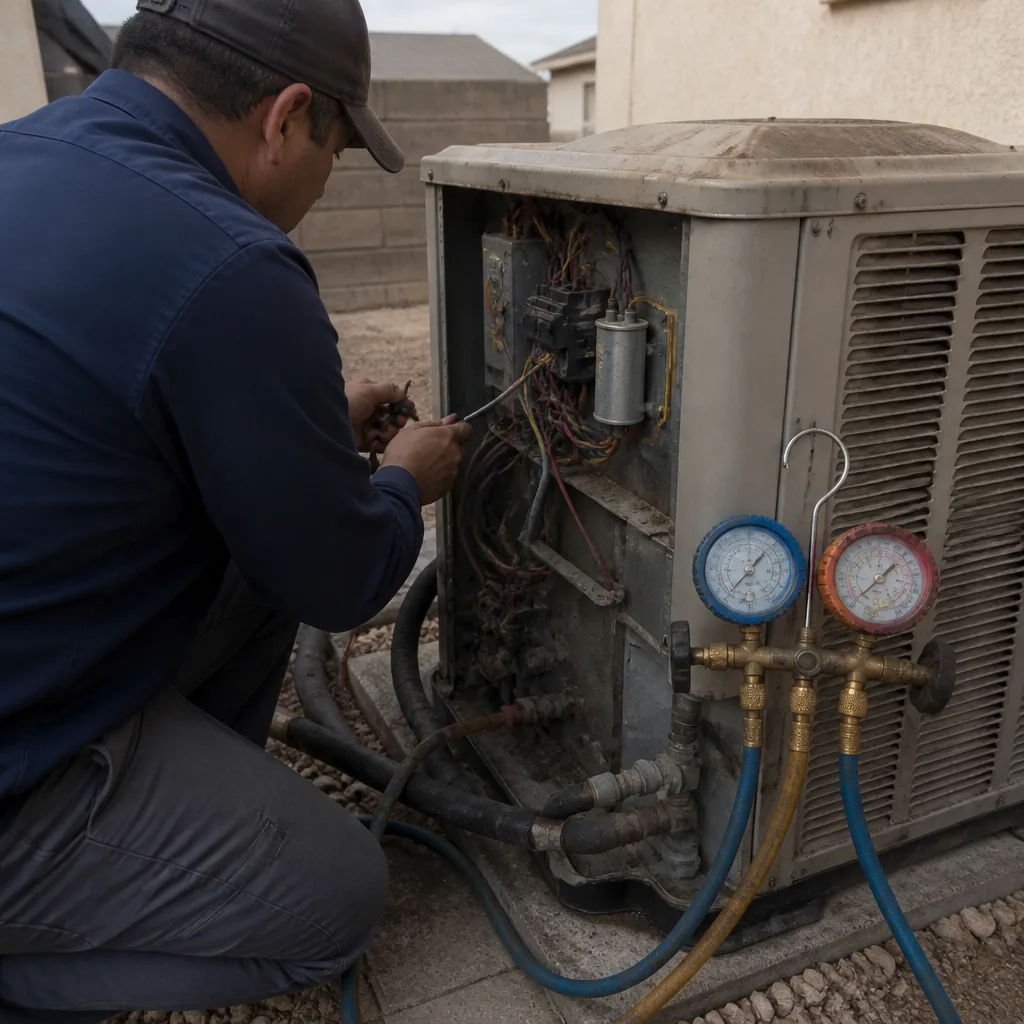 Before
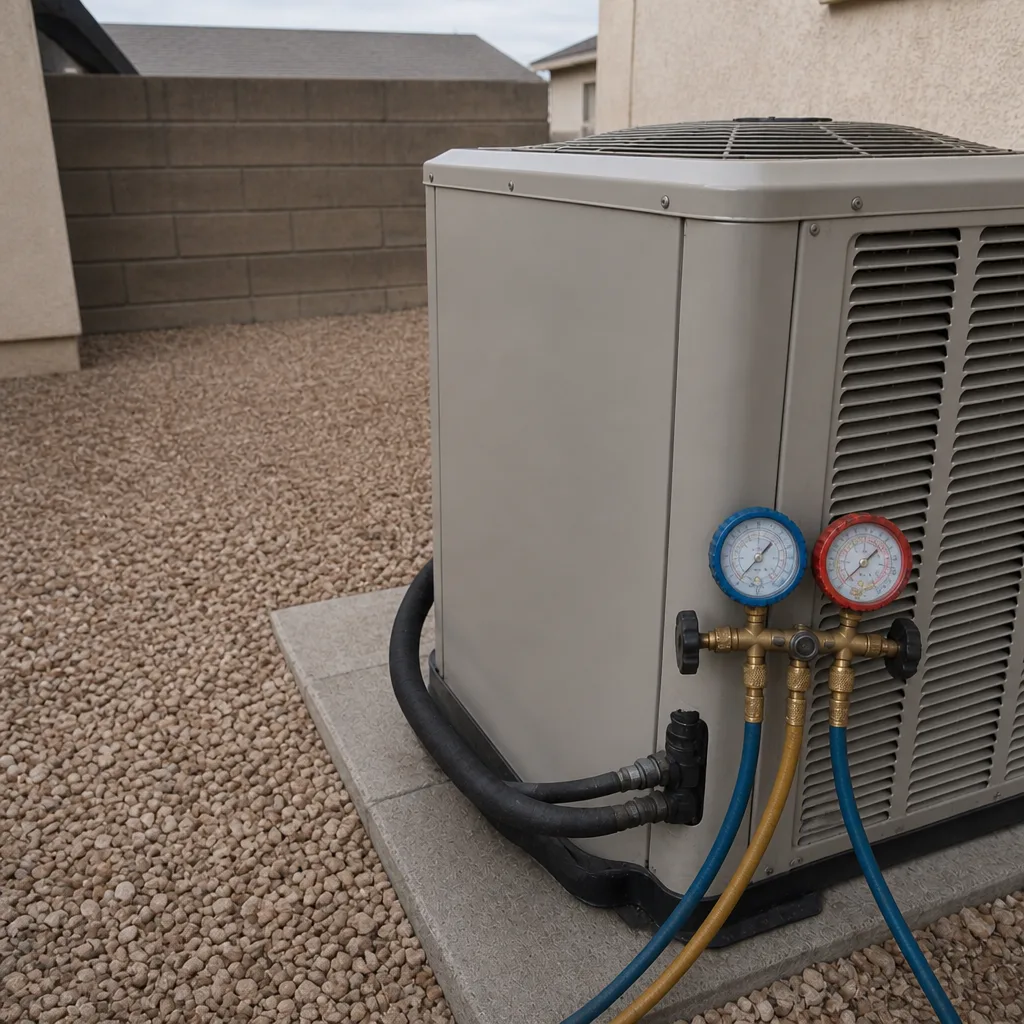 After
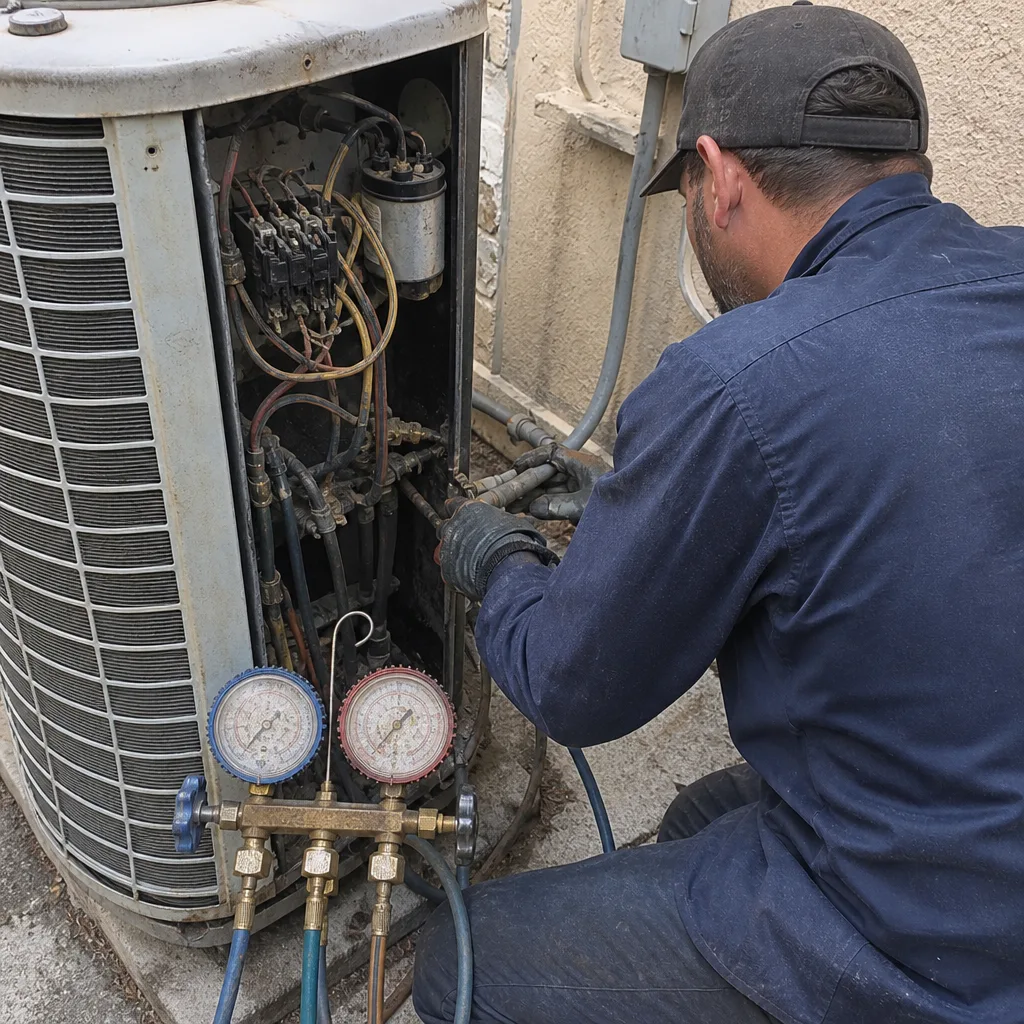 Before
 After
Frequently Asked Questions
The most reliable sign is a shrinking cycle time: the unit starts and stops faster than it used to, and the pattern repeats. Ice on the indoor coil or lineset, oily residue at the connection fittings, and a system that cools but never quite reaches setpoint all point to low charge. A technician confirms it with pressure and temperature readings on site. Call (844) 761-6871 for a free estimate on the diagnosis.
Ice in summer is a sign the system is low on refrigerant or starved of airflow, not a sign of too much cooling. Low charge makes the refrigerant expand too cold. A clogged filter, blocked return, or dirty outdoor coil chokes the system and causes the same result. Shut it off and get a diagnostic. Running an iced-over unit under load can destroy the compressor, which turns a $200 recharge into a $2,000 repair.
Musty smell is almost always biological growth in the drain pan or a partially clogged drain line, and it’s not a health emergency, though it’s unpleasant and worth fixing. Burning smell, by contrast, is electrical and should be treated as an emergency. Shut the system off and call. Refrigerant smell is rare but also a stop-and-call situation. Call (844) 761-6871 if you’re not sure which smell you have.
Once a year for most homes, and twice a year if you’re near a dusty lot, a cottonwood tree, or construction. The Las Vegas Valley’s dust and monsoon-pushed grit clog condenser fins faster than most climates. A yearly wash is the single cheapest way to extend compressor life, and it’s typically folded into an annual tune-up. Call for a free estimate on a maintenance visit.
Repair is almost always the right first call on a mini-split under about 12 years old. The most common causes of falling performance are a dirty coil, low charge, or a failing capacitor, and all three are inexpensive relative to a new system. Be wary of any quote that jumps to replacement before those are ruled out. We’ll tell you what we find and give you the numbers to compare. Call (844) 761-6871 for a free estimate.
Oily residue on the fittings, ice on the lines in summer, a system that loses efficiency over the course of the season, and a musty or sweet smell near the indoor unit (rare, but reported). Your electric bill climbing without a usage change is another signal. A leak search with electronic detection and pressure testing confirms it. We don’t top off without finding the leak first. Call (844) 761-6871 to schedule.
The Bottom Line
Mini-splits and heat pumps don’t usually die suddenly. They give notice, and the notice comes in short cycles, ice in summer, smells, creeping performance, and oily fittings. In a North Las Vegas summer, under constant load, that notice period is short. Watch your cycle times, do the monthly outdoor checks, and call the moment something changes. Ray’s Heating & Air has served the valley as a locally owned, owner-operated shop since 2002, with a 90-Day Done Right Promise in writing on every job. If your system is trying to tell you something, call (844) 761-6871. We’ll take a look, show you the readings, and give you the numbers before any work begins.
Written by the team at Ray’s Heating & Air North Las Vegas.